Description
100m SC/APC–LC/UPC Fiber Optic Patch Cord for FTTH Installations
The 100m SC/APC–LC/UPC fiber optic patch cord connects two points in a single-mode network with different types of optical ports. It has an SC/APC connector at one end and an LC/UPC connector at the other. This allows the technician to create a continuous optical path, provided that both equipment ports support the corresponding connectors.
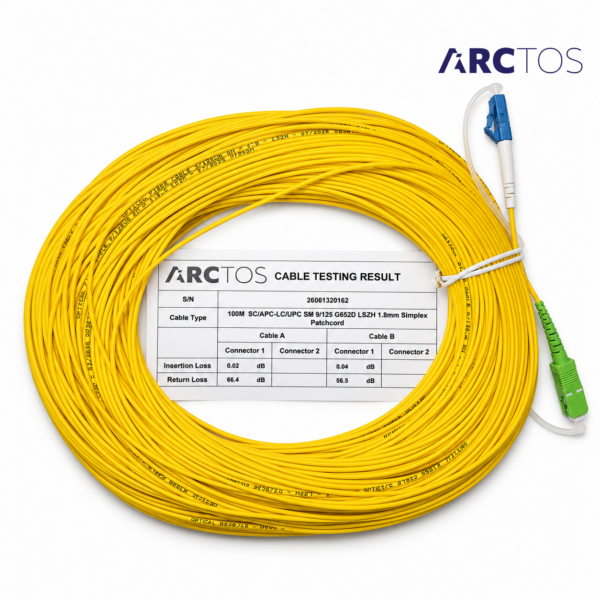
According to the test report shown in the photo, the cable features G652D 9/125 μm single-mode fiber, simplex construction, an LSZH jacket and an outer diameter of 1.8 mm. Its yellow color also helps installers identify the optical path while working.
Why Choose a 100m SC/APC–LC/UPC Patch Cord?
In many fiber optic installations, the distribution frame and active equipment use different types of ports. For example, one side may require SC/APC while the other requires LC/UPC. A suitable hybrid patch cord therefore enables the connection without a separate intermediate patch cord, where the cable route and ports allow it.
The 100-meter length also accommodates longer cable runs in compatible installations. Before installation, however, confirm the required length, how excess cable will be managed and the installation specifications.
SC/APC at One End and LC/UPC at the Other
In the photo, the green connector is SC/APC and the blue connector is LC/UPC. SC and LC describe the mechanical connector type, while APC and UPC describe the polish of the fiber end face.
Check compatibility: connect SC/APC only to a suitable SC/APC port and LC/UPC only to a suitable LC/UPC port. Do not directly mate an APC end face with a UPC end face. For further clarification, read the guide SC/APC vs SC/UPC and the comparison LC vs SC Connector.
Single Mode G652D 9/125 μm
The test report identifies the fiber as Single Mode G652D 9/125 μm. This is a category of single-mode optical fiber used in telecommunications networks. The technician should therefore use it with a matching single-mode optical path and compatible equipment.
Simplex Construction and 1.8 mm LSZH Jacket
Simplex construction means that the cable contains one optical fiber. The 1.8 mm outer diameter helps with cable organization along suitable routes, but the required bend radius must still be respected.
The LSZH (Low Smoke Zero Halogen) marking describes the jacket type. On its own, however, it does not establish a specific reaction-to-fire class or CPR certification. Such requirements need official technical documentation from the manufacturer.
Applications of the 100m Fiber Optic Patch Cord
This cable serves installations requiring a transition from SC/APC to LC/UPC along a single-mode optical path. After checking port compatibility, technicians can consider it for the following applications:
- FTTH or FTTx installations and connections.
- Optical distribution frames, ODFs and patch panels with SC/APC ports.
- Connection to active equipment with a suitable LC/UPC port.
- Single-mode optical paths in telecommunications and laboratory setups.
- Inspection or testing with instruments that support this connector type.
Before each connection, check the fiber type, optical port, connector polish and required length. Then check that the connectors are clean and protect the cable from sharp bends or mechanical stress.
Technical Specifications
| Specification | Value |
|---|---|
| Product type | Fiber optic patch cord |
| Length | 100 m |
| Connector A | SC/APC |
| Connector B | LC/UPC |
| Fiber Type | Single Mode (SM) |
| Fiber designation on the report | G652D |
| Fiber dimensions | 9/125 μm |
| Construction | Simplex |
| Jacket | LSZH |
| Outer Diameter | 1.8 mm |
| Cable Color | Yellow |
| Connector colors in the photo | Green SC/APC, blue LC/UPC |
The above information is based on identification of the photographed product and the markings on the ARCTOS test report. We do not have a separate datasheet from the original manufacturer.
Practical Installation Benefits
- Hybrid SC/APC–LC/UPC connection: Connects two different, compatible optical ports without changing their types.
- 100 m length: Provides a continuous optical path where the installation requires a longer patch cord.
- G652D single-mode fiber: Suitable for matching single-mode installations.
- Simplex: Provides one independent optical path.
- 1.8 mm jacket: Provides installers with a slim cable for appropriate routing and cable management.
- Distinctive yellow color: Makes the optical path easier to identify.
Package Contents and Compatibility
The photo shows an assembled patch cord with an SC/APC connector at one end and an LC/UPC connector at the other. However, we do not have an official packing list confirming additional components, accessories or accompanying documents for each item.
Before ordering, check that one of your ports is SC/APC and the other is LC/UPC. If you need SC/APC connectors at both ends, see the separate Patchcord SC/APC–SC/APC 100m from ARCTOS. These two products have different connectors and should not be confused.
Frequently Asked Questions
1. Which connectors does the patch cord have?
One end has an SC/APC connector and the other has an LC/UPC connector. It is therefore neither an SC/APC–SC/APC nor an LC/UPC–LC/UPC patch cord.
2. Is it suitable for FTTH installations?
Technicians can use it in a compatible FTTH or FTTx optical path requiring SC/APC at one end and LC/UPC at the other. The final choice, however, depends on the actual ports and network specifications.
3. What do G652D, 9/125 μm and Simplex mean?
G652D denotes the single-mode fiber category listed on the report. The 9/125 μm designation is the nominal fiber size used in commercial labeling, while Simplex indicates one optical fiber.
4. Can I connect SC/APC to an SC/UPC port?
No. Do not directly mate an APC end face with a UPC end face. Likewise, the LC/UPC end requires a compatible LC/UPC port.
5. What does LSZH mean?
LSZH stands for Low Smoke Zero Halogen and describes the jacket type. However, the marking alone does not prove a specific fire performance or CPR class.
6. Do the loss values on the report apply to every item?
Not necessarily. The photo includes a report for a specific test, rather than official guaranteed maximum values for every product. For measurements or acceptance limits, technicians should refer to the relevant technical document and test method.
Patch Cord Selection and Technical Support
To choose the right patch cord, first check the length and connector types required by both devices. You can also browse more fiber optic tools from ARCTOS Solutions.
For questions about SC/APC–LC/UPC connections or choosing a cable for your project, contact ARCTOS Solutions.
Technical Reference for G.652 Fiber
For general technical information about G.652 fibers, see the official ITU-T G.652 recommendation. The recommendation describes the fiber category and is not a certification or datasheet for this specific patch cord.